How Do Pharmacies Work?
There’s so much confusion about pharmacies, and how they work, and just the daily practical aspects of working with them. I thought I’d write up a post to try and clear up some confusion.
First off, let me tell you how I write a prescription.
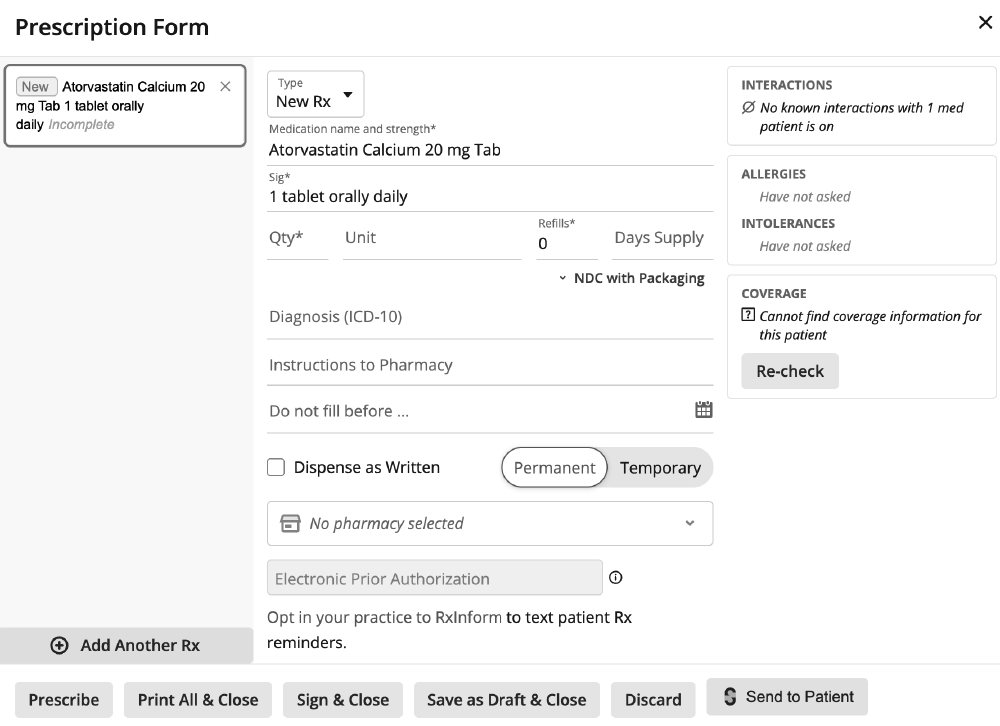
This is what the screen looks like when I order a new prescription for you: medication name, instructions, quantity, and refills.
In my medical record software, I click your name, and then choose a medication from a huge list of drugs in a database somewhere. Once I’ve chosen the exact product I want you to have, I write your instructions (like “take one by mouth every morning”), the number of pills (or amount of cream or whatever) you get at once, and then how many times it can be refilled.
That last part is kinda important: the number of refills. What that does is tell the pharmacy that I want you to be able to get this particular bottle of pills x number of times before the pharmacy needs to call me and ask for a new order.
So when you get a prescription, you can actually just let the pharmacy know you’re ready for the next refill, and they’ll get it ready for you. If they don’t have any more refills available, they will contact me automatically and I can renew the prescription (or refuse, and ask you to come in and talk to me first, or whatever).
For most medicines, I can write either a one month supply (let’s say, 30 pills for a once a day medicine) or a three month supply (90 pills). I usually put 5 refills on a 30 day supply, so it will last you six months before the pharmacy contacts me again. I put 3 refills on a 90 day supply, because those medicines are usually more stable and chronic, so I know they will call me in a year to get the next prescription.
The exception of course is when a medicine is a controlled substance. Many of you take ADHD medications like Adderall (oh who am I kidding, nobody with ADHD has made it this far in this post… I kid, I kid, I have it too!) The rules are different for those. I cannot send a prescription for more than 30 days of medicine, and I cannot put refills on them. You have to contact me each and every month to let me know you need more. It’s a real hassle! But that’s the rules.
So what about mail order pharmacies? Those are really the same thing, except they send the medicine in the mail. I send the prescription to them just like any other pharmacy, and they can contact me to get a new prescription when you need one. Pretty easy! Mail order pharmacies usually won’t do controlled medicines though, so again, controlled meds are a pain.
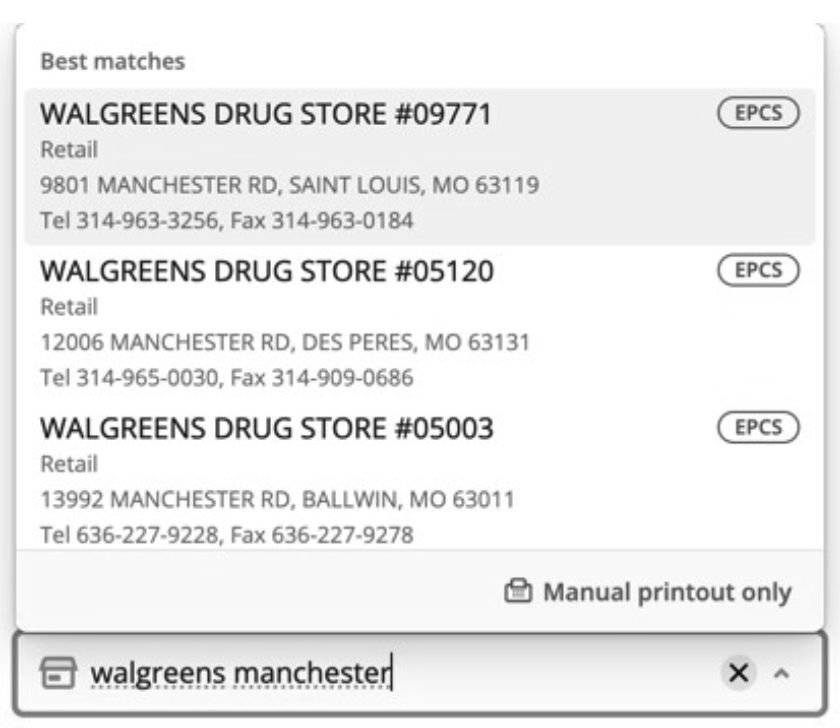
Sometimes I need a bit more detail in order to know exactly which location you want. In this example, if someone says “I want this sent to the Walgreens on Manchester,” you can see that there are multiple locations that that description applies to.
So, if you can share the address or phone number of the specific location you want, that saves time because we don’t have to go back-and-forth to find your preferred location.
By the way, if you ever send me a note to refill your medicine, it would be great if you’d include what pharmacy you want it to go to. I save your preferred pharmacy in our system, so if you decide you want to change that, let me know. If you don’t, I will tend to keep sending the medicine to your pharmacy on file, sometimes even when you explicitly tell me to send it elsewhere! (Like that patient today… sorry buddy!)
And, let me know some more identifying information of the pharmacy you want, not just “The Walgreens on Manchester.” The address or phone number is great! If you look at the example in the screen shot here, you can see there are multiple locations that fit the description of “Walgreens on Manchester.”
I also want to mention that CVS is a pharmacy chain that runs pharmacies that are their own freestanding buildings, and also inside stores like Target and Schnucks. If you tell me “The CVS in Brentwood” I usually don’t know which one you’re talking about. But if you tell me “The CVS in the Brentwood Schnucks,” I do! So I’m sorry if I am occasionally confused about that.
Let’s talk about what pharmacies make you pay.
This is a very complicated topic and sometimes I don’t understand it at all.
The easiest thing is if you’re paying cash, not using insurance. My advice is to use GoodRx, and search for the medicine you are getting, and look for a coupon. You don’t have to do anything at all to get the coupon, and it will work. Just make sure it’s for your dose, and for the correct pharmacy (the Walgreens one won’t work at CVS, for example).
If you’re using insurance though, it can be pretty hard to figure out what you’ll pay until you get to the pharmacy.
Most of the time, insurance plans have “tiers” of medicines, and you pay a different amount depending on the tier. A tier one is usually a “preferred generic,” meaning a non-branded drug that’s generally cheap, like atorvastatin. A tier two is usually a “nonpreferred generic,” which is a non-branded drug that’s more expensive, like albuterol inhalers. If a drug is branded, it’s usually Tier 3 or higher. Some plans have 5 tiers or more!
Prices usually go up by Tier. Tier 1 drugs are often some low amount, like $10. Branded drugs usually cost a percentage of the actual non-insured retail price. This can be a lot!
And finally, some drugs aren’t covered at all. If you get those, you just have to pay retail. That’s usually a lot of money. Better find a coupon!
But it can be more complicated than that. If your plan has a deductible, they might make you hit it before any benefit kicks in at all. So maybe a generic drug is $10, but only AFTER you have paid your deductible for the year. So a drug that is $10 in December might suddenly be $75 in January, because your deductible resets. When you meet the deductible, the price goes down again.
And finally, some drugs are only covered if specific criteria are met. For example, the weight loss GLP-1 drugs are usually like this. If I prescribe those, the insurance company puts a hold on the prescription, and then they (or the pharmacy) ask me to send them information to review. If it meets their criteria, they will cover the drug. If not, you’re out of luck. This is called a prior authorization and we do a lot of them. If they say no, you probably have to either pay retail price, or pick a different drug. (The GLP-1 drugs are usually only covered if you have diabetes, for instance.)
This is a long post already, so I’ll stop here. But you can also read about how to save money on medications using mail order pharmacies like Cost Plus Drugs in my article here, and you can read more about GLP-1 drugs and compounding pharmacies here.
Questions? Let me know!